Published on 30 April 2026
YouTube Creator Monetization: Online Courses, Personal Coaching and the End of Tool Stacking - Complete Guide 2026
Online courses and personal coaching are the two most powerful monetization levers for YouTube creators in 2026. But running both on a patched stack of Calendly, Stripe, and Zoom costs over $100/month, creates constant friction, and fragments the client experience. This guide breaks down what works, what doesn't, and why Citavivo is the infrastructure that was missing.
YouTube remains in 2026 the world's dominant video platform, with over 2.7 billion logged-in users watching more than a billion hours of content every day. Yet the vast majority of creators have come to the same conclusion: AdSense revenue alone is not a viable business.
YouTube's RPM (revenue per thousand views) typically ranges between $0.50 and $5 depending on niche and audience location. A creator generating 100,000 views per month can expect between $50 and $500 in ad revenue — a modest return for the hours invested in content production.
Creators generating meaningful, recurring income have diversified. According to eMarketer, creator revenue from direct fan support tripled between 2021 and 2024. The two most powerful levers: selling online courses and offering personal coaching sessions. This guide breaks down both models, the tools creators use to run them, the friction those tools create, and why Citavivo is the cleanest solution available in 2026.
Selling Online Courses: Turning Expertise into Scalable Revenue
Selling online courses is the most structurally impactful monetization model for a YouTube creator. It means packaging expertise into an on-demand learning program, sold as a one-time purchase or subscription.
Why this model works especially well for YouTubers
A YouTuber has something most sellers don't: a pre-existing trust relationship with their audience. Subscribers have already watched, validated the expertise, and recognized the value — before spending a single dollar. That organic social proof is the foundation every course seller tries to build from scratch.
YouTube content acts as a permanent acquisition engine. A well-optimized video on a targeted topic can generate qualified leads continuously for months or years. Tech creators regularly report three-year-old tutorials still driving hundreds of dollars monthly toward their paid offerings.
Course formats YouTubers typically sell
The most common formats are self-hosted video courses (recorded modules, PDFs, exercises), cohort programs with live sessions, private community memberships with exclusive content, and multi-day intensive bootcamps. Pricing varies widely: from $47 for a mini-course to over $2,000 for a full accompanied program.
The most profitable niches for YouTube course sales
High perceived-value topics generate the highest revenue: trading and investing, real estate, entrepreneurship, digital marketing, personal development, health and wellness, parenting, and language learning. These niches support premium pricing because the promised transformation has a clear, measurable economic or emotional value.
Some creators in high-value niches generate over $50,000 per month from course sales alone. The gap between a creator earning a few hundred dollars and one crossing that threshold rarely comes down to audience size — it comes down to offer structure, positioning, and the tools used to sell and deliver.
The core advantage: near-passive income
A course is built once but can be sold to thousands of people with no proportional increase in effort. That leverage is what separates the creator-entrepreneur from the traditional service provider. Once the sales funnel is in place, every new YouTube video becomes an acquisition channel feeding into that offer.
Personal Coaching: The Highest Unit-Value Offer
If the online course is the scalable model, personal coaching is the highest unit-value model. A 60-minute coaching or consulting session priced between $100 and $500 is entirely defensible once a creator has established expertise through their YouTube channel.
Who buys these sessions?
Primarily loyal subscribers who have watched enough content to trust the creator and now want personalized guidance for their specific situation. Also professionals who discovered the creator through a targeted YouTube search and want to accelerate their results. Personal coaching is typically the premium tier in a value ladder: course at entry level, individual sessions at the top.
Coaching session formats
The one-off session (30 to 90 minutes) addresses a specific problem. The client leaves with a clear action plan. It is the easiest format to sell because the commitment is low. A monthly coaching program includes several sessions spread over one to three months with check-ins between calls — the highest total value format. Async coaching involves written or voice note exchanges without live video: ideal for creators with high demand who want to serve more clients without filling their calendar.
Why coaching complements courses rather than cannibalizing them
Personal coaching doesn't compete with course sales — it completes them. The two offers serve different needs. Courses suit self-directed learners who want to work at their own pace. Coaching suits people who want direct, personalized help on their specific situation. Together they form a complete monetization ecosystem that maximizes customer lifetime value while diversifying revenue streams.
The Standard Tool Stack: Calendly, Stripe, Zoom and Friends
When a creator decides to launch a coaching or course business, they quickly find themselves assembling a set of independent tools. Here is the standard ecosystem used by most infopreneurs and online coaches.
Calendly — Appointment scheduling
Calendly is the undisputed leader in online scheduling. It lets clients self-book a slot based on the creator's availability, eliminating back-and-forth emails. It integrates with Google Calendar and Outlook and can automatically generate Zoom or Google Meet links on booking confirmation.
Pricing: Free (very limited) · Standard: $10/month · Pro: $15/month
Limitation: Integrated payment collection is only available on paid plans. The free tier only allows one active event type.
Stripe — Online payments
Stripe is the reference payment gateway for independent creators. It accepts credit cards, Apple Pay, Google Pay, Klarna, and bank transfers. It can be connected to Calendly (paid plan required) or embedded in a sales page via a direct payment link.
Pricing: 2.9% + $0.30 per transaction
Limitation: Every sale incurs fees. On a $200 session, Stripe takes roughly $6.10. On 100 monthly sales, that is $610 in transaction fees alone.
Zoom — Video calls
Zoom remains the standard for coaching video calls. Stable, universally recognized, available on all devices. It integrates natively with Calendly to auto-generate meeting links on booking confirmation.
Pricing: Free (40-minute limit per session) · Pro: $13.99/month
Limitation: The 40-minute cap on the free plan is incompatible with professional coaching sessions. The Pro plan is essentially mandatory.
Teachable / Podia / Systeme.io — Course hosting
These platforms host and sell video courses. Systeme.io is the most accessible all-in-one option with a free entry tier. Teachable offers more customization. Podia is beginner-friendly with unlimited students on its base plan.
Pricing: Systeme.io free (limited) · Teachable: $29/month · Podia: $33/month
Limitation: None of these natively handle personal coaching scheduling. Calendly and Zoom must be added on top.
Mailchimp / ActiveCampaign — Email marketing
Email remains the highest-converting channel for course sales. These tools send automated sequences to prospects, manage lists, and segment subscribers by behavior.
Pricing: Free up to 500 contacts · then from $13/month
Limitation: Requires a third-party integration (Zapier or Make) to connect with the course platform.
Zapier / Make — Automation
When tools don't integrate natively, Zapier or Make act as the glue: granting Teachable access after a Stripe purchase, adding a contact to the newsletter after a sale, syncing data across platforms.
Pricing: Free (very limited) · Plans from $20/month
Limitation: High technical complexity. Every automation is a potential point of failure requiring ongoing maintenance.
This full stack costs most creators between $100 and $150/month in fixed subscriptions, before Stripe's variable transaction fees and the hours spent maintaining integrations.
The Real Cost of Tool Stacking: Friction and Hidden Losses
Assembling independent tools is the default path for most creators. It looks economical on paper. In practice, it generates constant friction — for the creator and for the client.
Manual syncing between tools
A Stripe purchase doesn't automatically create access in Teachable. Without Zapier or Make, every new buyer requires manual intervention. Errors, delays, and missed steps hurt the client experience and the creator's reputation. A student who doesn't receive access within an hour of purchase creates a support ticket — and sometimes a refund request.
Fixed costs that don't scale down
Calendly Pro ($15) + Zoom Pro ($14) + Teachable ($29) + ActiveCampaign ($30) + Make ($20) = $108/month minimum. These costs apply regardless of revenue level. For a creator just starting out, this fixed overhead creates financial pressure before a single dollar is earned.
A fragmented, unprofessional client experience
The client receives a Calendly confirmation email, then a separate Stripe receipt, then a Zoom link in a third email. There is no visual coherence, no consistent branding. This fragmentation undermines the perceived value of the offer and makes premium pricing harder to justify.
Ongoing technical maintenance
A Calendly update, a Stripe API change, a Zapier token reset — maintaining integrations consumes time that should go toward content creation and improving the coaching offer. Every tool is a subscription to monitor, an interface to learn, and documentation to keep up with.
No unified view of the business
Revenue data lives in Stripe. Course analytics live in Teachable. Email metrics live in Mailchimp. Bookings live in Calendly. Getting a clear picture of the business requires manually exporting and cross-referencing data from four separate tools.
High drop-off at checkout
Every additional step in the purchase flow increases abandonment. A client who has to create a Teachable account after paying on Stripe, then receive a Zoom link in a separate email, can drop off at any stage. Research consistently shows that each additional checkout step reduces conversion by 10 to 20%. On a $500 course sold 50 times a month, every lost conversion point represents $2,500 in missed revenue.
The overloaded creator paradox: the more successful a creator becomes with this patched-together setup, the worse the problems get. More clients means more manual syncing, more support tickets, more time on non-creative tasks. Growth becomes its own obstacle if the underlying infrastructure isn't solid.
Platform Comparison
Several platforms attempt to offer a more integrated solution. Here is an honest comparison of the main options available to creators in 2026.
Calendly + Stripe + Zoom + Teachable stack — ~$100–150/month
Course hosting: yes (separate tool) · Personal coaching: yes (separate tool) · Integrated payment: yes (Stripe external) · Integrated calendar: yes (Calendly external) · Integrated video: yes (Zoom external). Every feature lives in a different tool. No native sync between them.
Systeme.io — Free (limited) then from $27/month
Course hosting: yes · Personal coaching: no · Integrated payment: yes · Integrated calendar: no · Integrated video: no. A solid entry point for course sales. Does not handle coaching scheduling or paid bookings.
Teachable — from $29/month
Course hosting: yes · Personal coaching: no · Integrated payment: yes · Integrated calendar: no · Integrated video: no. Strong for hosting courses. No booking or individual live session functionality.
Podia — from $33/month
Course hosting: yes · Personal coaching: no · Integrated payment: yes · Integrated calendar: no · Integrated video: no. Clean interface, great for beginners. Limited as soon as the creator wants to go beyond asynchronous course delivery.
MyKlub — from ~$49/month
Course hosting: yes · Personal coaching: yes · Integrated payment: yes · Integrated calendar: yes · Integrated video: partial (via Zoom). One of the few platforms combining courses and coaching. Video remains outsourced to Zoom.
Skool — $99/month
Course hosting: yes · Personal coaching: no · Integrated payment: yes · Integrated calendar: no · Integrated video: no. Community and gamification focused. High price point for a platform that doesn't cover individual coaching.
Citavivo — pricing at citavivo.com
Course hosting: no · Personal coaching: yes, native · Integrated payment: yes · Integrated calendar: yes · Integrated video: yes (with whiteboard). Citavivo is not a course hosting platform. It is the most complete solution for selling and delivering personal coaching: booking, payment, video call, and whiteboard in one tool, with no third-party integrations required.
Why Citavivo Is the Right Tool for YouTube Creators
Citavivo was built to address exactly the limitations described above. It is not a course hosting platform — it is a dedicated solution for selling and delivering personal coaching, with integrated video, whiteboard, scheduling, payment, and a branded client space, all in one tool.
Everything a creator needs to deliver coaching in one place
Citavivo centralizes everything needed to run a personal coaching business: availability management, online booking, integrated payment, and video calls with a shared whiteboard to replicate the classroom experience. The client accesses everything from a single client portal. For the creator, that means one interface, one subscription, one support team.
Native scheduling — no Calendly needed
Citavivo natively handles availability management and online booking. Payment, confirmation, and automated reminders are all managed in the same flow, with no third-party integration to configure. The creator sets their availability once, and the system handles the rest.
Unified checkout with no friction
Booking or payment: everything happens in the same flow. No redirect to an external gateway, no re-entering card details. The client books, pays, and immediately accesses their session slot. Every step removed from the checkout flow translates directly into higher conversion rates.
Fully branded client experience
Creators customize their space with their colors, logo, and visual identity. Clients interact with a coherent professional brand — not an assembly of generic third-party tools. Higher perceived value supports premium pricing and reduces refund requests.
Unified dashboard
Upcoming bookings, session history, client messages, and revenue — all visible in one place. No more manually cross-referencing Stripe, Teachable, and Calendly to understand how the business is performing.
Fast setup, no technical skills required
Citavivo requires no development skills, no automation tools, no API configurations. No Zapier, no Make, no webhooks. The creator focuses on what they do best — creating content and coaching clients.
Concrete ROI
Replacing a $100+/month tool stack with Citavivo simplifies infrastructure and improves the client experience. The most significant impact is indirect: a frictionless client journey directly improves conversion rates. On a $200 coaching session sold 20 times per month, a 10% conversion gain means 2 additional sessions — $400/month in added revenue generated purely by removing friction from the booking flow.
The Coaching Opportunity for Creators Who Haven't Started Yet
Many YouTubers already selling courses haven't yet launched a personal coaching offer. Often out of concern about time, perceived complexity of setup, or uncertainty about how to structure and price it. Yet personal coaching is one of the fastest revenue opportunities to activate for a creator who already has an engaged audience.
The fastest offer to launch
Unlike a course that requires weeks of production (recording, editing, curriculum design), a coaching offer can be live within hours. Define your positioning, set your pricing, open your availability, and start accepting bookings. The expertise already exists — it's exactly what you share in your YouTube videos.
How to structure your first coaching offer
Start from a specific, recurring problem your audience raises regularly in the comments. If your community frequently asks "how do I do X" or "can you review my Y," that's a clear signal of coaching demand. Define a clear format (duration, deliverable, method), price it in line with the perceived value of your expertise, and begin with a limited number of slots to test and refine.
Concrete example: courses plus coaching in practice
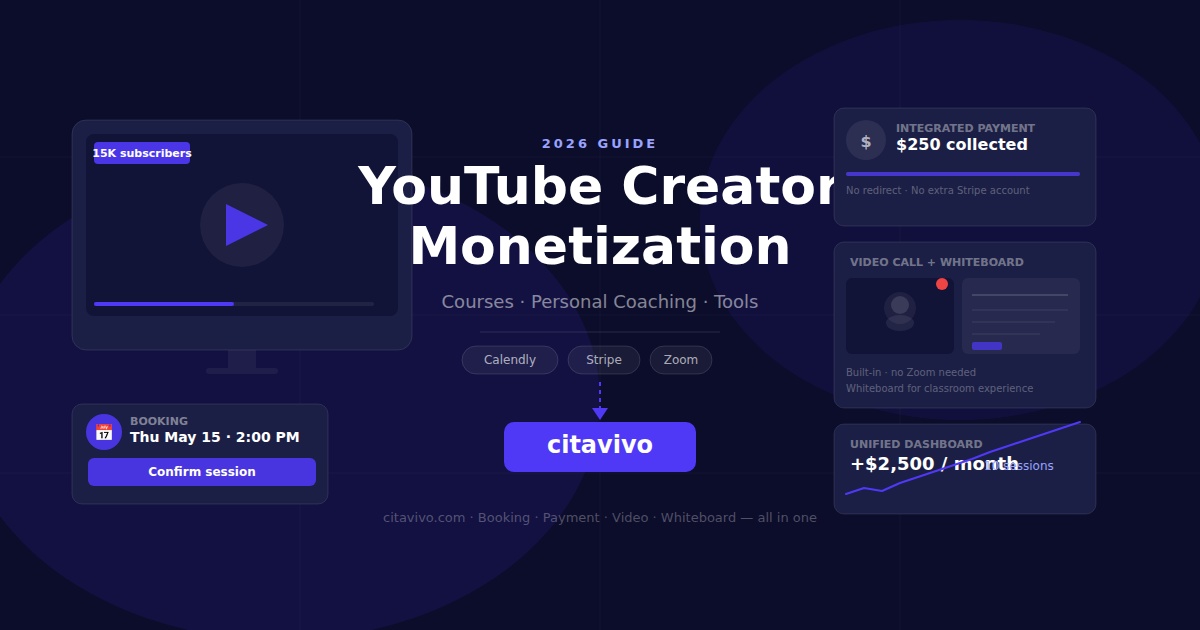
A YouTube creator in the investing niche with 15,000 subscribers already sells a course on Teachable for $197. By adding a 60-minute personal coaching session at $250 on Citavivo (portfolio review, live video with whiteboard), they can potentially generate $2,500 in additional monthly revenue with just 10 sessions. Booking, payment, and the session itself are all handled in one tool — no Calendly, no Zoom, no separate Stripe account.
Who benefits most from combining courses and coaching
The creators who extract the most value from this model are those in high economic-value niches (finance, real estate, digital marketing), coaches and therapists using YouTube as an acquisition channel, B2B experts (SEO consultants, digital strategists, LinkedIn trainers), and creators with a highly engaged but relatively small audience. Deep engagement with a small community often converts better than a large passive following.
Conclusion: Build the Infrastructure to Scale
In 2026, monetizing a YouTube channel is no longer about waiting for AdSense deposits. Creators generating significant, durable income have all reached the same conclusion: own your distribution and sales channels.
Online courses provide the scalability lever. Personal coaching provides the highest unit value. Together, they form a complete, resilient revenue ecosystem — independent of YouTube's algorithm changes.
But that ecosystem only functions well with the right infrastructure. Patching together Calendly, Stripe, Zoom, and a separate course platform creates constant friction that costs time, money, and clients.
Citavivo is the direct answer to that problem: a platform built for content creators who want to sell and deliver personal coaching, with integrated video and whiteboard, without compromising on client experience or brand quality. For a creator serious about monetization, it's the infrastructure that was missing.